Hydraulic Winches for Offshore Deck Work
In short
- Offshore decks favour hydraulic winches because they give the most force for their size and shrug off shock, salt water and continuous duty.
- Two numbers size a hydraulic winch: pressure sets the pull, and flow sets the speed, both measured at the motor, not at the pump.
- Offshore lifting is governed by recognised standards such as EN 14492-1 and DNV 2.7-1, and serious equipment is built and often classed to suit.
Step onto almost any working offshore deck and the winches you see will be hydraulic. There is a reason for that, and it is not habit. The combination of force, robustness and tolerance of a brutal environment is something a hydraulic drive delivers naturally, and it is exactly what deck operations demand. Understanding why, and how such a winch is sized, helps you specify the right unit instead of the cheapest one that fits the footprint.
Why offshore decks run on hydraulics
A hydraulic motor produces the highest force for its weight of any common drive, which matters when deck space and crane capacity are precious. Just as important, it tolerates what the sea throws at it. Shock and snatch loads from a moving vessel, a soaking with salt water, a high duty cycle that never really stops, all of these would stress a standard electric winch, yet a hydraulic unit takes them in its stride. Where a deck already runs a hydraulic power pack for a crane or other gear, adding a winch costs little, which is why the whole deck tends to standardise on oil.
Pressure and flow: the two numbers that size a hydraulic winch
Sizing a hydraulic winch comes down to two figures, and getting them right is the whole game. Pressure, measured in bar, sets the torque and therefore the pull, while flow, measured in litres per minute, sets the speed. A winch that needs a given pull at a given speed needs both the pressure and the flow to be available at the motor, not merely promised at the pump. A long hose run, an undersized valve or a cold, thick oil will drop the pressure and starve the flow, and the winch will fall short of its data sheet exactly when the load is at its worst. We always state what a winch needs at its motor inlet, so the power pack and the pipework can be matched honestly.
| On an offshore deck | Hydraulic winch | Standard electric winch |
| Force for its size | Highest | Good |
| Shock and snatch loads | Tolerates well | Stresses the drive |
| Salt water and washdown | Shrugs it off | Needs protection |
| Continuous heavy duty | All day | Watch the duty cycle |
| Power source | Deck power pack | Mains or generator |
Sizing from the power pack, not just the winch
A hydraulic winch is only ever half of the system. The power pack, the pump, tank, valves and cooler that feed it, decides what the winch can actually do. Specify a winch for 210 bar and 120 litres per minute and then feed it from a pack that delivers 160 bar through a thin, hot line, and you have bought disappointment. Good practice is to size the pack and the pipework around the winch with margin, to keep the oil clean and cooled, and to plan the valves for smooth, controllable movement rather than an on or off lurch. On a deck where several functions share one pack, the flow has to be shared sensibly so the winch is not robbed when the crane is working.
Classification, standards and the offshore environment
Offshore is a regulated world, and the winch has to fit into it. Power driven winches are covered in Europe by EN 14492-1, which sets out how the rated capacity, the brake and the overload protection behave, while offshore lifting appliances and containers are addressed by DNV 2.7-1 and related rules, with a higher safety factor for anything that lifts people. Serious offshore equipment is built to these standards and is frequently certified or classed by a society such as DNV, ABS, BV or Lloyd's, with documentation and traceability to match. A toy grade winch cannot meet this, which is one of the clearest lines between equipment for an offshore deck and gear sold on price alone.
Where hydraulic winches earn their place
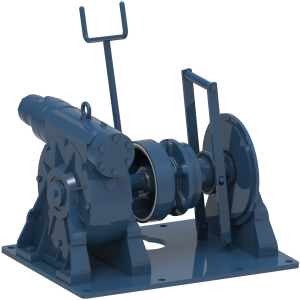
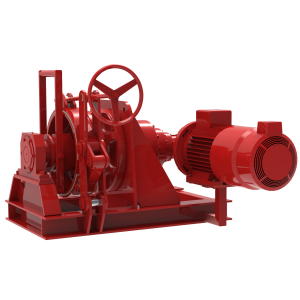
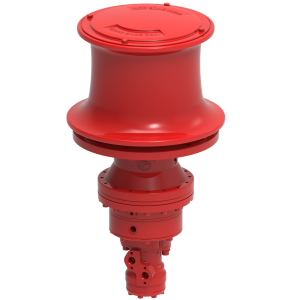
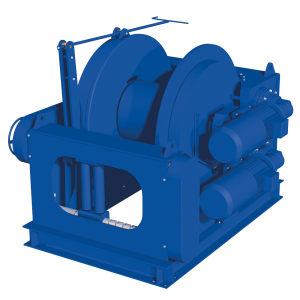
The duties stack up quickly on a working vessel. There is mooring and warping, where a capstan holds and renders line as the ship moves. There is deployment and recovery of equipment over the side, where the load hangs free and the swell never sits still. There is towing, anchor handling and skidding of heavy modules across the deck. Each of these asks for force, control and durability together, the exact blend a hydraulic drive provides. For warping and mooring our hydraulic capstans cover a wide range of pulls, and for personnel duty the hydraulic man riding unit is built to the higher standard that lifting people demands.
Working with the motion of the sea
One thing sets an offshore winch apart from a workshop unit: the deck never stands still. When a load hangs over the side, the vessel heaves under it and the rope tension swings with every wave. A simple winch fights this blindly, snatching the load and shock loading the rope. The serious answer is motion control, from a well tuned brake and smooth hydraulic metering at the basic level, up to active heave compensation that pays out and hauls in to keep the load steady against the sea. Hydraulic drives suit this because they meter flow precisely and absorb shock without complaint.
This is also why the brake and the holding behaviour matter so much offshore. A load that must hang while the deck moves needs a brake that holds without power and a system that fails safe, so a lost supply stops the load rather than dropping it. None of this is exotic, it is simply what the environment demands, and it is built into equipment designed for the job rather than bolted onto a winch that was only ever meant to pull along a floor. When you brief us for an offshore duty, tell us the significant wave height you expect to work in, the rope angle and whether the load ever passes over people or a structure, because those facts change the specification as much as the pull and the speed do.
Matching real hydraulic winches to the deck
To put numbers to it, our hydraulic capstan range runs from compact units up to the heavier C 305 H and C 306 H for serious deck pulls, while the MR 000H covers hydraulic personnel work. The full programme is in our winch catalogue, and if you are still weighing drives, our guide to electric, hydraulic or pneumatic sets out the trade offs. For the calculation behind pull, drum and speed, our principal EMCE publishes a clear winch calculation reference.
Frequently asked questions
Why are offshore winches usually hydraulic rather than electric?
Because a hydraulic drive gives the most force for its size and tolerates shock loads, salt water and continuous duty that would stress a standard electric winch. Where a deck already runs a power pack, adding a hydraulic winch is also efficient and compact.
What sizes a hydraulic winch, pressure or flow?
Both. Pressure sets the pull and flow sets the speed, and both must be available at the motor inlet, not just at the pump. A long hose, a small valve or cold oil will reduce them and leave the winch short of its rating.
Do offshore winches need to be classed?
Offshore lifting is governed by standards such as EN 14492-1 and DNV 2.7-1, and equipment is frequently certified or classed by a society such as DNV, ABS or BV, with full documentation. Personnel lifting carries a higher safety factor again.
Can one power pack run several deck functions?
Yes, but the flow has to be shared sensibly so the winch is not starved when the crane or another function is working. The pack and pipework should be sized with margin around the combined demand.